
May 4, 2026 | Robert Campbell
9 min read
AI generative search has changed the way people procure life’s amenities, and non-profit sector websites are not exempt from this new reality and indeed may now be more closely observed by all stakeholders.

Entity SEO Can Make a Growth Chain Reaction
Entity SEO is a powerful lever NGOs can pull to start a growth chain reaction. Performing an Entity SEO audit and then engaging in a relatively minor website overhaul can dramatically increase AI visibility and positively affect your content’s stickiness and application. It’s a growth chain reaction because Entity SEO increases content visibility in search engines, which increases trust, which increases user participation, which raises more support and fuels more growth.
What is Nonprofit Search Engine Optimization?
Nonprofit SEO is the practice of optimizing a charity’s website to rank higher in search results, increasing visibility to donors, volunteers, and those in need, without paying for any type of advertising. The process typically involves targeting mission-specific keywords (using them in context in the headers and body copy), creating valuable content, enhancing local search presence, and building credible backlinks to foster trust and engagement.
What is Entity SEO?
While traditional SEO chases keywords and rankings, Entity SEO focuses on more fundamental organizational concepts. We outline entities of all descriptions. We’ll start by clearly defining who and what your organization is, what it does, where it operates. We also explore who is involved, so that search engines can confidently present your NGO to someone searching to donate, volunteer, partner, or access services.
For nonprofits and NGOs, this shift can become competitive as each organization is competing with other charities for donations, media coverage and inclusion at marque events. When your NGO is modeled as a well-defined entity, meaning it’s backed up by structured data, consistent naming, and strong off-site signals, Google and other systems find it easier to surface your official pages, show richer results, and connect your work to relevant topics and people. That translates into more qualified visitors, higher donor confidence, and greater discoverability for your programs.

Building Blocks of Entity SEO for NGOs
Let’s walk through the building blocks of Entity SEO for NGOs and look first at how executive team bios and governance pages can reinforce your legitimacy by tying real people and their credentials to your organization. We’ll examine how thoughtful internal linking and carefully chosen anchor text can help search engines understand relationships between your organization, its projects, and its partners. Then we’ll explore how schema markup (like Organization, NGO, Event, and FAQ) turns your website into machine-readable evidence of who you are and what you do. Finally, we’ll touch on off-site signals such as directory listings and media mentions and how aligning them with your on-site entity model can create a coherent, trustworthy presence across the web.
Three Things About Entity SEO in General
1. Semantic Structure Over Keyword Density: The strategic evolution involves moving beyond basic keyword optimization to focus on semantic clarity, logical organization, and self-contained content units that maintain their value even when extracted and synthesized.
2. E.E.A.T at the core of everything. Entity SEO takes the Experience, Expertise, Authoritativeness, and Trustworthiness (E-A-T) concepts we’ve been optimizing for since Google’s major algorithm updates and enhances them for AI evaluation at a massive scale.
3. Anticipatory Content Architecture (Query Ecosystem Optimization) User intent optimization requires some expertise understanding how AI systems expand queries to create content that anticipates related questions. Offering such tailored solutions in your webpages greatly increases inclusion.
NGO Homepage Essentials for Entity SEO Conformance
Core entity building blocks for NGOs
Think of your NGO’s “entity graph” as a structured map of:
1. The NGO itself (legal name, acronyms, former names, registration, locations).
2. Causes (issue areas, SDGs, programs, campaigns).
3. People (founders, directors, notable staff, ambassadors).
4. Places (countries/regions of operation, local offices, project sites).
Improve EEAT Score with Detailed Executive Team Bios and About Us / Governance Pages
Executive team bios and governance pages give donors, partners, and beneficiaries concrete proof there are real, qualified people who work everyday advancing your charity’s mission. Create detailed profiles that highlight leadership experience, sector expertise, and relevant qualifications to help audiences quickly assess whether your team can credibly deliver the outcomes you promise. This kind of transparency is especially important for NGOs, where donors can’t really ‘kick the tires’ in person, and must often rely on what they see online to judge competence and seriousness.
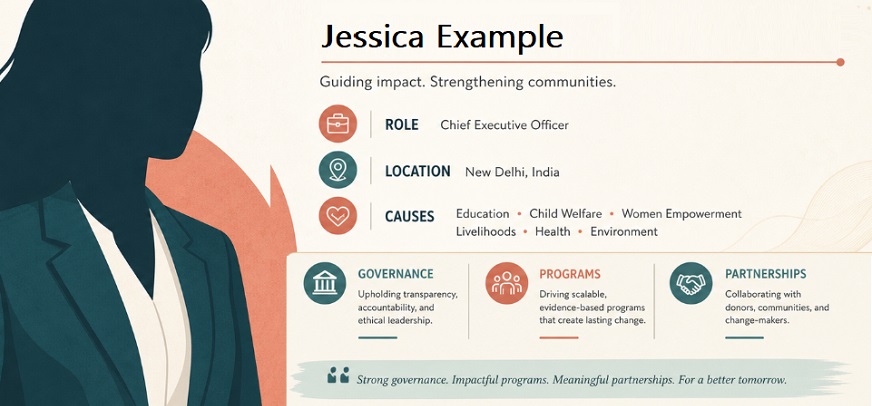
Well-structured governance pages go a step further by showing how your organization is run, who is accountable, and what systems are in place to ensure ethical and effective decision‑making. Clearly listing your board of directors, advisory committees, and key officers, and publishing their biographies, demonstrates that oversight is not theoretical but embodied in identifiable individuals.
When visitors can trace a line from your mission to specific leaders, roles, and responsibilities, your charity feels less like an abstract brand and more like a well-governed institution they can trust with their money and reputation.
From an Entity SEO perspective, these bios and governance pages also act as high-value signals that connect your organization’s entity to the entities of its leaders in the wider web graph. Including affiliations, degrees, certifications, awards, and notable prior roles in leadership bios allows search engines to associate your charity with recognized institutions and expertise, reinforcing both authority and topical relevance.
Consistent naming conventions, structured data, and internal linking from program and campaign pages back to leadership and governance content then help search engines understand that “this specific team runs this specific organization and these specific initiatives,” strengthening both discoverability and perceived legitimacy.
Create a More Cohesive Entity by Adding Internal Links
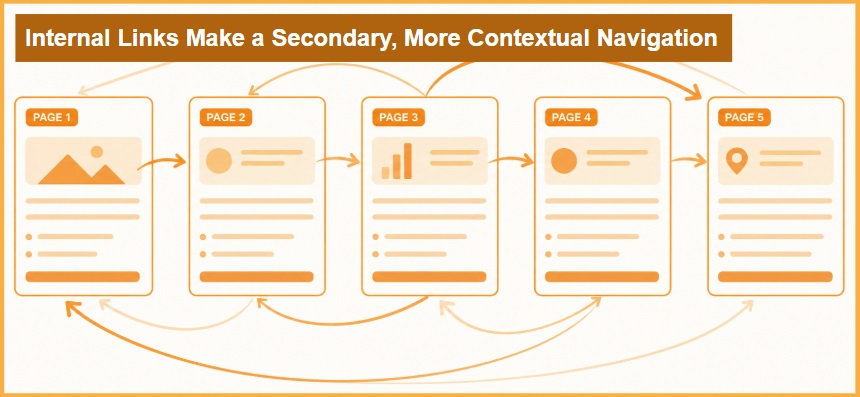
Thoughtful internal linking, overarching entity map on the homepage, is one of the simplest but most powerful ways to teach search engines how the different parts of your charity fit together. When you consistently link from broad, high-level pages (like your “About” or “Our Impact” page) to more specific program, campaign, and partner pages, you’re effectively drawing a labeled map of your organizational structure.
Your new homepage entity map helps search engines recognize which pages represent your core entity, and which pages are child entities such as projects, local initiatives, or strategic partnerships. A clear internal linking pattern also helps concentrate authority on your key pages, making it more likely that your official content will rank for important queries around your name, causes, and services.
Carefully chosen anchor text adds another layer of clarity by describing what each page represents in natural language that search engines can parse. Generic anchors like “click here” or “learn more,” are not very helpful, while phrases such as “youth mental health counselling program in Toronto” or “our partnership with XYZ Foundation” explicitly signals the relationship between your organization, the project, and the partner involved.
Over time, a consistent use of descriptive, entity-rich anchors reinforces how search engines categorize each page and how they connect it back to your main organization. It also makes it easier for users and machines alike to follow the narrative of who you are, what you do, and who you work with, which is exactly the kind of coherence that strengthens your overall Entity SEO.
Structured Data and Schema for NGOs
Entity SEO for NGOs is largely implemented through consistent schema markup plus good internal and external linking.
Foundational schema types:
Organization / NGO: For the main entity (legal name, logo, URL, sameAs, contact info, registration, founding date).
LocalBusiness or Organization with multiple location entries: For offices, clinics, shelters, or chapters to tie into local and map-based queries.
Event: For fundraisers, galas, webinars, volunteer days, and awareness campaigns with date, place/online link, and tickets/donation URLs.
Project / CreativeWork / Service: For specific programs (“Food bank in Scarborough”) so that each recurring initiative becomes its own recognizable entity.
FAQPage and HowTo: For evergreen FAQs (eligibility, how donations are used) and how-to content (how to become a volunteer, how to host a fundraiser).
Critical implementation details:
Put comprehensive Organization schema on the homepage and, if applicable, separate schemas on location pages, each referencing the main org via parentOrganization or branchOf.
Use sameAs to link to the NGO’s official profiles (Wikipedia if available, social channels, major directory listings, Charity Navigator / GuideStar equivalents, UN or government registries).
Mark up every major event and campaign page so they are eligible for event and rich result features, improving visibility when people search for ways to help.
Links Drive Entity SEO
Off‑site signals such as directory listings, charity databases, social profiles, and media mentions extend your entity well beyond your own domain and act as third‑party “citations” that your organization is real and reputable. When your charity’s name, description, and NAP details (name, address, phone) are consistent across these profiles, search engines can more confidently merge them into a single, unified entity instead of treating them as fragmented or possibly unrelated references. This consistency also helps search systems disambiguate your organization from others with similar names, and it reassures users that they are looking at the same charity whether they find you on Google, a charity evaluator, or a partner’s website.
Aligning those off‑site signals with your on‑site entity model takes you beyond Local Search fundamentals and into deeper layers of trust. It’s not just about matching NAP data; it’s about mirroring the way you present your organization, leadership, programs, and partnerships everywhere you appear online. When your governance structure, key people, flagship projects, and core cause areas are reflected in press bios, partner pages, and directory descriptions in ways that harmonize with your website, search engines see a stable, well‑corroborated graph of relationships. That level of alignment signals maturity and accountability, which in turn makes it more likely that your charity will be treated as an authoritative source for its topic areas, not just another local listing.

Summary Takeaways
Entity SEO for nonprofits is about making your organization legible to machines as well as people. Instead of focusing only on keywords, let’s instead define your charity as a clear, consistent organism. We’ll cement your organization’s name, mission, leadership, programs, locations, and partners so search engines can confidently present it to the right audiences. When done well, this powers a growth chain reaction as richer results earns stronger trust signals, and better visibility for everything from donations and volunteering to service access and advocacy.
If you want to move beyond basic SEO and build a durable, entity‑driven presence for your nonprofit, this is where specialized help pays off. Reach out to the SEO team at KPD-I.com to design and implement an Entity SEO strategy tailored to your charity’s goals, governance, and programs.
