

November 12, 2025 | Jason Maher
5 min read
You don’t build a website just for some people — you build it for everyone.
That includes the more than eight million Canadians over age 15 living with physical, sensory, or cognitive disabilities. For them, the internet isn’t a luxury, it is a vital connection to services, community, and opportunity. But for many, that connection breaks when they hit a site that simply isn’t built to include them.
At KPDI, we believe accessibility isn’t just a checklist, it’s a responsibility. Because every click, form, and page should be easy to use, regardless of how someone interacts with technology.
Why Accessibility Belongs at the Core of Your Web Strategy
Whether you’re a business owner, a nonprofit director, or part of a digital team, accessibility should be woven into your design from day one, not added at the end.
When users with hearing, vision, or mobility challenges can’t navigate your website, the impact is bigger than frustration. It means lost engagement, missed revenue, and an avoidable exclusion of real people who want to connect with you.
Accessibility expands your audience, strengthens your reputation, and improves everyone’s experience including your “average” user. Clearer navigation, faster load times, and well-structured content help search engines and humans alike.
The Four Principles of Accessibility (POUR)
At the heart of WCAG standards are four guiding principles; the foundation of every accessible experience.
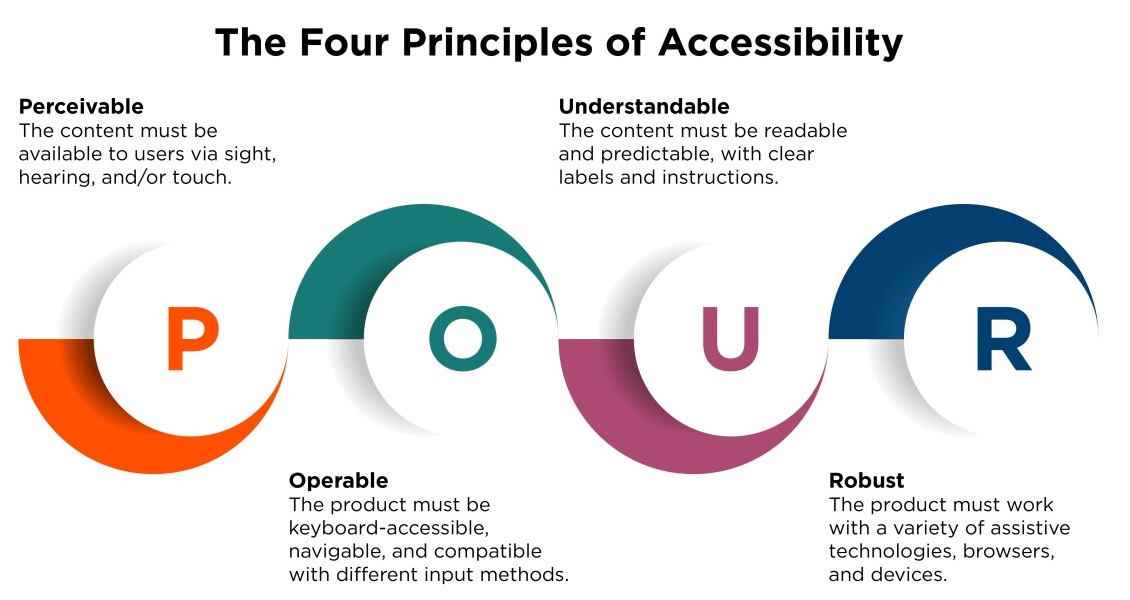
These principles — Perceivable, Operable, Understandable, and Robust — ensure that digital content can be accessed and enjoyed by all users:
- Perceivable: Content must be available through sight, hearing, or touch. Users should be able to perceive all information presented, whether through text alternatives, captions, or tactile interfaces.
- Operable: Websites should be navigable and usable with different input methods — keyboards, voice commands, adaptive switches — not just a mouse.
- Understandable: Content must be readable, predictable, and clear, with labels and instructions that make sense for everyone.
- Robust: A website must work seamlessly with assistive technologies, browsers, and devices now and in the future.
Together, these principles create a digital environment that welcomes everyone, regardless of how they access it.
The Evolving Standard: WCAG 2.2
The Web Content Accessibility Guidelines (WCAG) are the global gold standard for inclusive web design. Developed by the World Wide Web Consortium (W3C), these guidelines outline how to make websites usable for people with a wide range of disabilities from vision and hearing loss to mobility and cognitive challenges.
The newest version, WCAG 2.2, published in late 2023, introduces additional criteria to better support mobile users, people with limited dexterity, and those with cognitive or learning differences. Meeting WCAG 2.2 not only ensures your site meets today’s standards, it also future-proofs your digital presence as technology and expectations evolve.
What Accessibility Looks Like in Practice
Accessible design is about removing barriers, often in simple, powerful ways.
- Screen-reader and voice-control compatibility — Structuring pages with logical headers, semantic HTML, and alt-text helps users who rely on assistive tech.
- Keyboard navigation — Ensures users who can’t use a mouse can still browse, click, and fill out forms.
- Readable, responsive design — Adequate color contrast, scalable text, and mobile-friendly layouts improve usability for everyone.
- Faster performance — Properly optimized media loads faster, reducing frustration across all connection speeds.
- Built-in SEO advantage — Search engines love structured, accessible content. Accessibility and discoverability go hand-in-hand.

Beyond Compliance: The Broader Benefits
Accessibility isn’t only about meeting regulations. It is about building trust and empathy into your digital experience.
Closed captions help in noisy offices. High-contrast text helps aging eyes. Voice navigation helps multitaskers. Inclusive design benefits everyone, not just those with disabilities.
And from a business perspective, accessible sites:
- Reduce legal risk
- Improve SEO and page rankings
- Increase conversions and retention
- Strengthen your brand reputation
- Perceivable: Content must be available through sight, hearing, or touch.
Users should be able to perceive all information presented, whether through text alternatives, captions, or tactile interfaces. - Operable: Websites should be navigable and usable with different input methods — keyboards, voice commands, adaptive switches — not just a mouse.
- Understandable: Content must be readable, predictable, and clear, with labels and instructions that make sense for everyone.
- Robust: A website must work seamlessly with assistive technologies, browsers, and devices now and in the future.
In short: accessibility pays off — ethically and commercially.
Our Perspective at KPDI
At KPDI Digital, we’ve been designing inclusive websites long before accessibility became a buzzword. Our approach is rooted in human-first design, combining empathy, data, and the latest standards to create experiences that welcome every user.
We don’t just help our clients meet compliance — we help them lead with inclusion, setting the bar higher for what great digital experiences can be.
If your organization is ready to audit or elevate your accessibility, we can help you meet WCAG 2.2 standards while improving overall performance and engagement.
Let’s make the web a place where everyone belongs.
Contact us →
